Joy of Reading

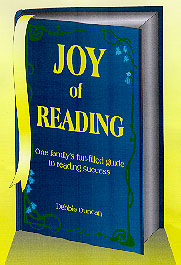
Book cover yellow text on blue background

I share my family’s success stories (as well as a few flops) and our favorite books in Joy of Reading: One family’s fun-filled guide to reading success. Joy came out in 1997, a year before we all started reading Harry Potter. While hundreds of new books have been added to our library since then and my daughters are all now in their twenties, the books and essays about reading are still relevant to 21st century families.

“Weaving in anecdotes and commentary, (Duncan) has created far more than an annotated reading list. Reading Joy of Reading is more like having a conversation about books with a good friend.”

Newport Beach/Costa Mesa Daily Pilot

“. . . browsing in it (Joy of Reading) will give you years of titles to look for, and a contagious enthusiasm for the way Duncan and her husband, Bill, have turned their three daughters into bookworms.”

San Jose Mercury News

Where to Buy

Buy directly from the publisher Rayve Productions | Buy from Amazon

Filled With Glee

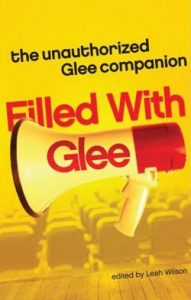
Book cover containing megaphone against auditorium backdrop

I’m a theater geek. My kids were in dozens of children’s theater shows. I’m the co-author of three children’s musicals. So of course I love Glee. I jumped at the chance to enter a contest I heard about on Twitter to write an essay on any aspect of my favorite TV show. And I won! Every Girl Needs a Kurt is included in the fun new book perfect for any Gleek, Filled with Glee.


Where to Buy

Smart Pop Books | Kindle edition from Amazon

The World According to Twitter

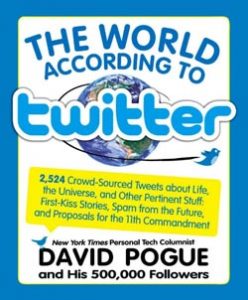
Book cover containing globe in blue and white theme

I don’t mind saying I love Twitter. Why? It helps me make contacts, leads me to good (most of the time!) information, allows me to interact with other writers and reporters in real time and find out what’s going on at the moment. It’s also fun. David Pogue, who knows all things tech, was one of the first tweeps I followed. He started posing funny, or sometimes poignant, questions every night, then retweeting the best answers. I laughed my way to bed. I also submitted a few replies. He liked my answer to the question “What’s the weirdest job you ever had?” and that’s how I ended up as a co-author of The World According to Twitter. I’ve left this book out on our coffee table. People who don’t even like Twitter giggle their way through it!

Where to Buy

Amazon | IndieBound

Everlasting Daylight

(August 7, 2017) Hear the audio version

While you were adjusting to the changing climate or catching up on the latest White House scandal, the state Assembly, once again, considered scrapping daylight time. After all, Arizona and Hawaii don’t have it. Springing forward in March and falling back in November is disruptive: traffic accidents and heart attacks go up, productivity dips. But … it turns out getting rid of an hour of light at the end of the day is wildly unpopular with parks and rec departments, Little League, surfers, runners and other casual exercisers, and the Facebook group “Save the Light.” Contrary to folklore, farmers don’t care one way or another.

So the latest proposal is permanent daylight time for California.

Seriously. That’s about as likely to happen as Calexit, the on-again, off-again idea for California to secede from the U.S. Did state Assembly members consider the complications before voting in favor of Assembly Bill 807 and sending it on to the state Senate?

Let’s stop for a moment. Under permanent daylight time, the sun wouldn’t rise till 8:25 AM in January when kids go back to school in the dark after winter break. Also, imagine being in a different time zone than Oregon and Washington—but only from the first Sunday in November to the second Sunday in March. Heck, most people now don’t realize it’s PDT, not PST, until November 5th.

California operates in a global economy. Do we really want to make it harder for the rest of the world to do business with us in order to have everlasting daylight saving time?

For this goofy idea to become reality, the bill needs approval by the state Senate. Then it would go on the ballot—because Californians can always use another issue to vote on. If that passed, Congress would need to approve the change. And we all know how much the U.S. Congress loves California. I don’t know whether it’s time to shake my head or laugh. I think I’ll laugh.

With a Perspective, I’m Debbie Duncan.

Update: the California legislature failed to pass this flawed bill in 2017. Woohoo!

#MeToo

(October 18, 2016) Hear the audio version

At first I thought it was just me.

When I heard Donald Trump bragging in a 2005 videotape of being able to sexually assault women, to “do anything” to them because he was a star, my heart began to race. I had an immediate flashback to the week before my high school graduation, when the senior minister of my church groped and chased me. An ordinary school night ended up with me managing, barely, to lock myself in a room and call my parents for help.

It didn’t take long to learn I was not the only woman having flashbacks. I read, then joined the “tweet me your first sexual assaults” Twitter stream started by writer Kelly Oxford. Many of us shared stories that have haunted us for years, of teachers, ministers, family members, bosses or other co-workers, ex-boyfriends, men on public transportation, drunk party boys and the like grabbing us where they shouldn’t, of exerting their power over our bodies because they felt entitled to do so. The New York Times called the result “a kind of collective, nationwide purge of painful, often long-buried memories.” Within five days, Ms. Oxford had received more than 30 million replies.

The hashtag for these personal stories is #notokay—because every person, not just men who have wives, daughters or granddaughters, must acknowledge that sexual violence is wrong. We need to make sure our children of all genders know it.

I was more fortunate than many survivors of sexual assault. My mom and dad believed me. I left for college 3,000 miles away. I did not accuse the groper publicly, though he also never ran for president.

Let this be a moment of national reckoning on rape culture. We have an opportunity for a turning point—to use the madness of this presidential campaign to help end sexual violence. Because that is, and always will be, #notokay.

With a Perspective, I’m Debbie Duncan.

Qigong

(September 3, 2016) Hear the audio version

A year ago I had a scary heart incident, called Takotsubo, that landed me in the ICU. Thankfully, I recovered with no long-term damage. Because Takotsubos are thought to be stress-induced, my cardiologist encouraged me to learn to manage stress.

I began by taking the eight-week mindfulness-based stress reduction course, which got me to start meditating. I discovered I’m not very good at silent meditation. I think too much. Yet I stayed with it, and for the first time in three years, I didn’t get a migraine two days after Christmas. Hmm. So I took another class at the hospital: Mindful Qigong. That practice has changed my life.

I’ve known about tai chi, the martial arts form of qigong, for quite a while. I used to see old people stand in poses in the oak grove outside my office on Friday afternoons. In qigong, we move as we focus on our breathing. I may have failed to finish three yoga classes in the past year, but qigong I can do. The exercises are slow and rhythmic, and have been used for thousands of years in China to preserve and restore health. My mind is quiet when I practice qigong. Nothing matters. It’s awesome.

So now I am one of those silly looking old(er) people. I drive 25 miles to get to class at the rec center by 9:00 Saturday mornings. My fellow students and I follow along as Marcy, or Sadao, leads us in a series of simple movements that both relax and energize. For me it’s like acupuncture without needles. And I can do it myself!

Every evening before bed, I follow a qigong YouTube video or DVD for 15 minutes. That’s all it takes. I’ll also stand up and swing my arms between innings at a Giants game, or in an airport lounge. I’m not shy. My heart is back to normal, I sleep better, and I have migraines under control.

Stress? Thanks to qigong, I’m getting better at it.

With a Perspective, I’m Debbie Duncan.

Something Smells in the USA

I wrote this Perspective in the Summer of 2016. My editor thought it was too political to put on the air, but I like it so I’m putting it on my website. I was right, damn it!

It smelled like a good idea at the time.

You see, I love the scent of fresh honeysuckle. After repeated failures to grow plants in my yard, I started harvesting flowers from wild bushes in the neighborhood when honeysuckle blooms in late spring. I float the fragrant blossoms in bowls on my kitchen counter.

So when I saw honeysuckle-scented essential oil diffuser sticks at a local clothing store in June, I bought a box. That evening I immersed the reeds in the oil and turned them upside down in the vase, as instructed. My daughter emerged from her room. “Whoa! That’s strong.”

“Maybe it needs to … diffuse,” I said. My eyes watered as I carried the vial and sticks out to the far corner of the living room, behind closed doors. Alas, the overpowering, decidedly non-honeysuckle scent traveled through and under the doors. I didn’t dare leave the thing in the house overnight, so I relocated it to the garage. Next morning, it was as if I had to breathe in a toxic cloud to get to my car.

Clearly, I had to admit I’d made a mistake and dispose of the liquid. I couldn’t pour it in a sink or even down a storm drain—that flows to the bay! So I held my breath and flung the elixir onto the ivy in front of my house, where it stunk up and down the street for weeks. I was too embarrassed to apologize to my neighbors.

My honeysuckle debacle reminds me of this year’s presidential election. People are hurting. Government in Washington is dysfunctional and the middle class is disappearing. A major party nominee who has never held elective office promises, without providing specifics, that he alone can fix the problems. Trust him, he says. And that smells good to a chunk of the population, no matter what else the candidate says or tweets. Yet if enough voters buy what he is selling, will we, a year from now, have to apologize to neighbors and allies for the stinks a temperamental president has gotten our country into? That’s a risk someone who knows about mistakes at the checkout counter is unwilling to make in an election.

With a Perspective, I’m Debbie Duncan.

Takotsubo

(October 12, 2015) Hear the audio version 

It was a hot September night a few weeks ago, the evening after construction noise had kept my family awake beginning at 2 AM. When the decibels rose at 9:30 PM, I went out to investigate.

Klieg lights illuminated the site across the busy street behind our back fence for all-night digging by a huge tractor-like jackhammer. I managed to get the workers’ attention. “What are you doing?” I hollered. “People are trying to sleep over here!” They got off the tractor and went to confer with co-workers. I took pictures with my cell phone to send to the police. When I turned around to walk home, I got a sudden pain in my right jaw. I stopped. I’d read recently that women’s heart attack symptoms could be different from men’s. Was jaw pain one?

Yes, it was. By the time I had a blood test in the ER an hour later, my cardiac enzymes were 300 times normal. I was having what’s called stress-induced cardiomyopathy. I had a heart attack even though I exercise every day, eat all my fruits and veggies and have normal cholesterol. (I am on medication for high blood pressure, which is why I went to the hospital without ever having chest pain or shortness of breath.) After a night in the ICU, my new cardiologist’s suspicion that this was stress-induced was confirmed by an angiogram. He saw ballooning of my heart muscle. My arteries are “pristine.” This was not my grandfather’s heart attack.

Japanese doctors identified this type in 1990 and called it Takotsubo. It wasn’t even recognized in this country until 2001. Ninety percent of Takotsubo patients are female. It’s usually triggered by a sudden, stressful event to a woman who is already dealing with stress or sorrow. In my case, it was probably my brother’s recent death. Takotsubo cardiomyopathy is sometimes called broken-heart syndrome. Although it can be fatal, I expect to recover in weeks.

In the meantime, I’ve signed up for mindfulness-based stress-reduction class at the hospital. And when workers return for overnight noise-making, we close the windows.

With a Perspective, I’m Debbie Duncan.

Losing Your Place

(August 5, 2014) Hear the audio version

Sometimes a gym is more than a place to work out. Mine, the Page Mill YMCA, is a mile down the hill from my house in a far-from-fancy facility in the basement of a Palo Alto office building. This low-cost gym has developed quite a community in its 35 years—hosting everything from racquetball tournaments to classes for those with Parkinson’s or recovering from cancer treatment, as well as TRX, spin, Zumba, Tai Chi, yoga, etcetera. The teachers are terrific. Members have donated generously to YMCA summer camps in underserved communities, food and backpack drives, and the like. They’ve formed lunch and dinner groups. At least a quarter of the members are 65 or older. I’ve made friends of all ages in my 6 AM bust-our-buns total body resistance workout. It’s the sort of exercise the lead Alzheimer’s researcher at Stanford has said can improve cognitive function.

Unfortunately, this facility is set to close October 1st, when the lease expires. The first time members were informed that the gym’s future was in any jeopardy came in a June 24th letter. The Y’s reasons for the closure, which are changing weekly, have raised suspicions and hackles. Thousands of comments have been posted on local news sites. Hundreds—mostly older people—showed up for a dinnertime meeting at a Palo Alto church to hear from Silicon Valley Y executives, and for them to hear from us. Managers still say the decision is “irreversible,” but that hasn’t stopped members from forming a save-the-gym task force and coming up with creative ways to continue operating. This is Silicon Valley, after all.

We Baby Boomers are getting up there in age. We want and need a reasonably priced gym for our physical, mental and social well-being, one we don’t have to commute more than half an hour to get to. The entire community loses when the needs of any sector are ignored.

We who work out want very much to work this out. Places where we can indulge the modern value of personal health and fitness plus the old-fashioned value of a caring community are not easy to find around here. Let’s hope a way can be found to keep what we have.

With a Perspective, I’m Debbie Duncan.

Another Brandon

(May 15, 2014) Hear the audio version

Perhaps you’ve heard that the San Francisco Giants have three players on the team this year named Brandon. Their lockers are next to each other’s. They’ve turned some nifty Brandon-to-Brandon-to-Brandon double plays. Dodger Stadium celebrity P.A. announcer Justin Bateman even referred to the Giants’ shortstop as “Another Brandon.”

know what it’s like to have a common name: Deborah was one of the top-ten baby girl names every year of the 1950’s. There were five Debbies in my second-grade class. Twenty-five percent of that class was a Debbie/Debby … including the boys! There was another Debbie Duncan in my high school. She didn’t show up for detention, and my geometry teacher blamed me. I’ve memorized my medical record number, as there are four Deborah Duncans registered at my HMO. My brother David Duncan’s name is even more common.

According to the Social Security Administration, Deborah dropped out of the top 100 names right after I graduated from college. It’s now #797. William, my husband’s classic, non-decade-, or even century-specific name, is still going strong at #5.

Also common now among baby boys: names ending with the letter “n”—not just Brandon, but Aiden, Ethan, Jalen, Jayden, Mason, Morgan, etcetera. Thirty-six percent of 2012 newborn boys’ names ended in “n.” I see a New Yorker cartoon caption about that in the future, a variation of the one a while ago with a class picture of Michael, Jennifer, Michael, Michael, Jennifer, Jennifer … and so forth. (Michael was the #1 boy’s name 1961-1998, Jennifer for girls, 1970-1984.)

Coming up with a name for your baby is fun, but also challenging. Daunting. I fretted over it three times. Unless you’re Gwyneth Paltrow and can get away with calling your child Apple, you’re probably going to want a name that won’t encourage teasing. It should also be a name substitute teachers can pronounce, but that isn’t so trendy there will be five of them at their trigonometry table. My daughter Molly could tell you that.

With a Perspective, I am Debbie Duncan.